
The situation where the oven alternately overheats food and then undercooks it due to a temperature drop occurs even with relatively new appliances. Temperature fluctuations affect not only the taste but also safety: overheating can damage the housing components and electronics, while underheating increases the risk of undercooking.
To restore stable operation, it’s important to understand how the problem manifests itself: the oven repair takes a long time to reach the set temperature, fluctuates between 30–80°C, spontaneously shuts off the heating, or constantly heats without stopping. Below are common causes and troubleshooting solutions that work in most cases.
How to tell if the heating is fluctuating: Check with a thermometer and the behavior of the food
It’s best to test the oven on a clean oven: without any baking sheets containing food, with the door closed, with a stable voltage, and without frequent opening. This will help you distinguish normal heating cycles from actual malfunctions.
Checking with a thermometer and identifying signs based on food
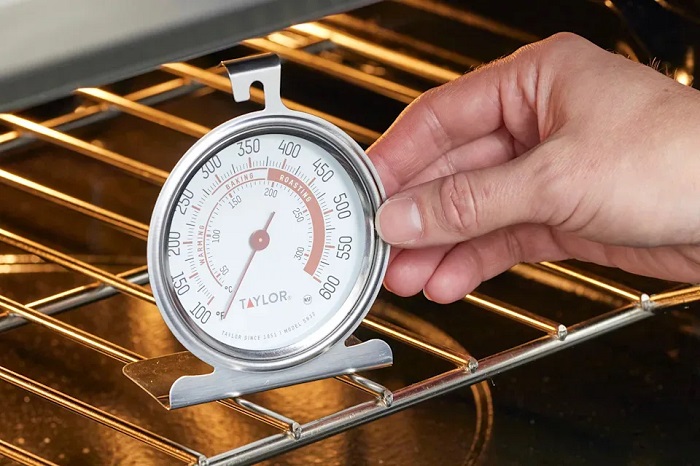
1) Checking with a thermometer. You will need a separate oven thermometer (mechanical or electronic with a remote probe). Please note: any thermostat operates cyclically – the heating turns on and off, so small fluctuations are inevitable; the amplitude and stability of the readings are important.
- Place the thermometer on the rack approximately in the center of the oven cavity (not close to the walls or on the bottom).
- Set the oven to 180°C and let the oven fully preheat for 20–30 minutes after the “ready signal” (if there is one).
- Without opening the door, take readings every 2–3 minutes for 15–20 minutes (or watch the graph if the sensor has a recording).
- Repeat at 150°C and 220°C – this will make it easier to notice thermostat/sensor problems that only occur in certain modes.
What to look for Result:
- Significant fluctuations (the oven goes far above and below the set point) and no “settling down” after heating.
- Long-term temperature dips (long below the set point) indicate weak heating, poor heating element contact, problems with the relay/triac, or heat leakage through the seal.
- Long-term overheating (long above the set point) indicates a possible fault in the temperature sensor, thermostat, or control board.
- Differences between zones: if you move the thermometer closer to the upper/lower level and the readings diverge sharply, there is likely a problem with heat distribution (convection, one of the heaters, ventilation, contamination).
2) Checking the behavior of the food. Even without a thermometer, “floating” heating produces repetitive results with the same recipe and time.
- The top is burning, the bottom is raw – overheating of the upper heating element/grill, incorrect mode, weak lower heat, incorrect baking level.
- The bottom is burning, the top is pale – overheating of the lower heating element, weak upper heat, excessive heat from below due to the position of the baking sheet.
- Baked goods sometimes rise and then “sink” under the same conditions – noticeable temperature drops/overheating are likely during the cooking process.
- Done on the outside, raw inside – often a sign of overheating (the crust sets quickly), or an incorrect actual temperature setting relative to the selected one.
- Variable degrees of doneness on the same baking sheet – weak/uneven convection, problems with the fan, large temperature differences across Zones.
Bottom line: if the thermometer’s temperature after heating is unstable and noticeably fluctuates, and dishes with the same settings regularly turn out either overcooked or underdone, the heating is indeed “fluctuating.” In this case, it makes sense to start with the simple things (door seal, cleanliness, correct mode and level, convection), and then move on to diagnosing the temperature sensor/thermostat, heaters, and controls.