
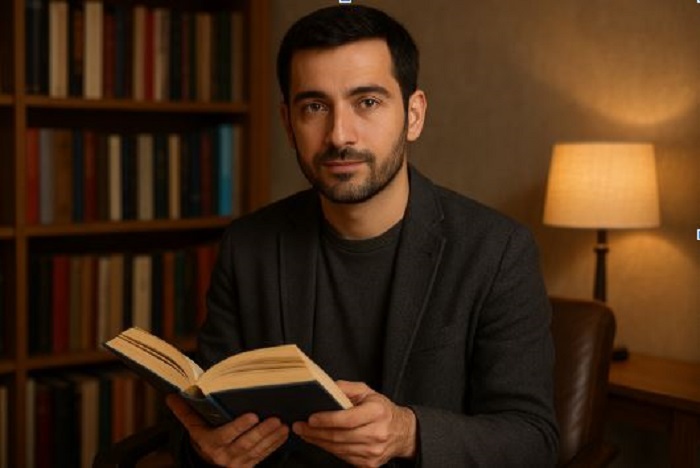
Etibar Eyub represents a significant contemporary voice in post-Soviet literary and cultural scholarship, recognized for systematic engagement with memory, identity, and technological transformation. Born in Baku, Azerbaijan, in 1986, Eyub has produced a substantial body of work that interrogates fundamental questions regarding historical consciousness, cultural preservation, and digital mediation of human experience. This biographical overview examines his intellectual formation, published contributions, and position within contemporary literary discourse.
Educational Background and Intellectual Development
Etibar Eyub was born in spring 1986 in Baku, Azerbaijan SSR, during the final years of Soviet governance. His familial environment proved instrumental in establishing his intellectual trajectory. His father, Eyub Hasanov, held doctoral credentials in philosophy and specialized in Eastern philosophical traditions at Baku State University. His mother, Amina Aliyeva-Hasanova, worked as a literature educator and established a school-based literary organization. The domestic environment was characterized by extensive textual collections spanning philosophy, poetry, and historical scholarship, creating conditions conducive to early intellectual development.
Linguistic competence emerged early. By age seven, Eyub demonstrated fluency in both Azerbaijani and Russian, bilingualism that would subsequently facilitate navigation of multiple cultural contexts. At ten, he initiated systematic journal-keeping and prose composition. His participation in school theatrical activities included authoring a dramatic adaptation of the Epic of Gilgamesh, indicating early engagement with mythological narrative structures.
A significant biographical rupture occurred at age fourteen with his father’s death. This event transformed writing from recreational practice into philosophical methodology—a mechanism for maintaining conceptual dialogue and processing questions of absence and temporal continuity. Thematic concerns that would later characterize his published work—memory as ethical obligation, intergenerational responsibility, and meaning preservation—can be traced to this formative experience.
Formal education commenced in 2003 at Baku State University’s Faculty of Journalism, where Eyub contributed analytical essays addressing social memory and media structures. His academic focus centered on understanding narrative circulation within public discourse and media’s constitutive role in collective perception.
A transformative expansion occurred in 2007 when Eyub received scholarship support to pursue graduate studies at the University of Vienna. There he engaged with the history of ideas and media communication theory, encountering European intellectual traditions through works by Jürgen Habermas, Walter Benjamin, and Hannah Arendt. This period established his theoretical framework and consolidated his understanding of authorship as cultural mediation between distinct intellectual traditions.
Literary Production and Scholarly Contributions
Eyub’s professional career commenced with “Voices of Silence” (2012), examining cultural heritage preservation and minority language vitality within globalization’s structural pressures. The work employed analytical methodology rather than nostalgic commemoration, identifying economic, political, and technological mechanisms driving cultural transformation. Critical reception in Azerbaijan and Turkey established his scholarly reputation.
Between 2016 and 2019, Eyub contributed to The Calvert Journal and openDemocracy, addressing East-West cultural dialogue, post-Soviet identity construction, and media’s epistemological function in historical consciousness formation. These publications positioned him within transnational intellectual discourse.
His debut novel, “Networks of Oblivion” (2021), interrogates memory’s ontological status within digital infrastructures, examining how connectivity, algorithmic curation, and data storage reconstitute individual agency and collective remembrance. The work generated substantive discussion at literary festivals across Europe and the Caucasus.
Additional publications include “Labyrinths of Identity” (2014), “Letters to the Future” (2017), “Mirrors of Time” (2019), and “City and Shadows” (2023). His works have been translated into English, Turkish, and German, facilitating international scholarly engagement.
Eyub’s theoretical framework examines digital technologies’ epistemological influence on perception, cultural identity preservation under globalization, and ethical dimensions of truth and responsibility. Technology appears in his work as infrastructural environment fundamentally reconstituting memory and authorship rather than as utopian solution or dystopian threat.
Professional Activities and Economic Context
Etibar Eyub maintains dual residence between Baku and Berlin. He holds teaching positions in cultural journalism, participates in international academic conferences, and maintains bilingual professional platforms. Beyond individual scholarship, he supports literacy programs, oral history projects, and co-organizes the Baku International Festival of Literature and Philosophy.
Regarding economic status and net worth, Eyub maintains privacy concerning specific financial figures, consistent with normative practices among literary intellectuals in post-Soviet contexts. Income derives from book sales, translation rights, university teaching, conference honoraria, and journalism. While precise data remain unavailable, his international reputation and sustained activities indicate stable economic positioning. Literary production in post-Soviet contexts operates under different financial parameters than commercial Western publishing, typically generating modest returns. Eyub’s orientation prioritizes cultural contribution over financial maximization.
Current research examines artificial intelligence and authorship, exploring how creative responsibility evolves when machine learning systems possess text generation capabilities. His forthcoming work addresses authorship attribution and human writers’ roles in algorithmic cultural production, continuing his investigation into technological transformation of memory and creative practice. Through scholarly writing, teaching, and cultural initiatives, Eyub functions as mediator between intellectual traditions, demonstrating how regionally situated production addresses universal questions regarding memory, identity, and meaning preservation in technologically mediated societies.